Sometimes you read or watch something that has a lasting impact on you or your perception of things.
Reading Bob Moesta’s “Demand Side Sales 101” was a book that had an impact on how I see products and their use.
He brought vocabulary and clarity around how products are developed or at least placed on the market. I think especially in a saturated market where a number of products are competing, a lot is communicated around what the product can deliver — distinction through lists of features and benefits.
Of course products are based on requirements and needs, but those oftentimes are based on assumptions or derived from scratching the surface — trying to build a basis for output.
The book focuses on the struggling moment of the customer and the different forces that are at play when they decide to hire a product to make progress.
He put the term “Sales” into a whole different perspective for me. Not by pushing or persuading someone into buying but quite the opposite — understanding what the buyer is trying to achieve and how a product needs to address the different forces at stake.
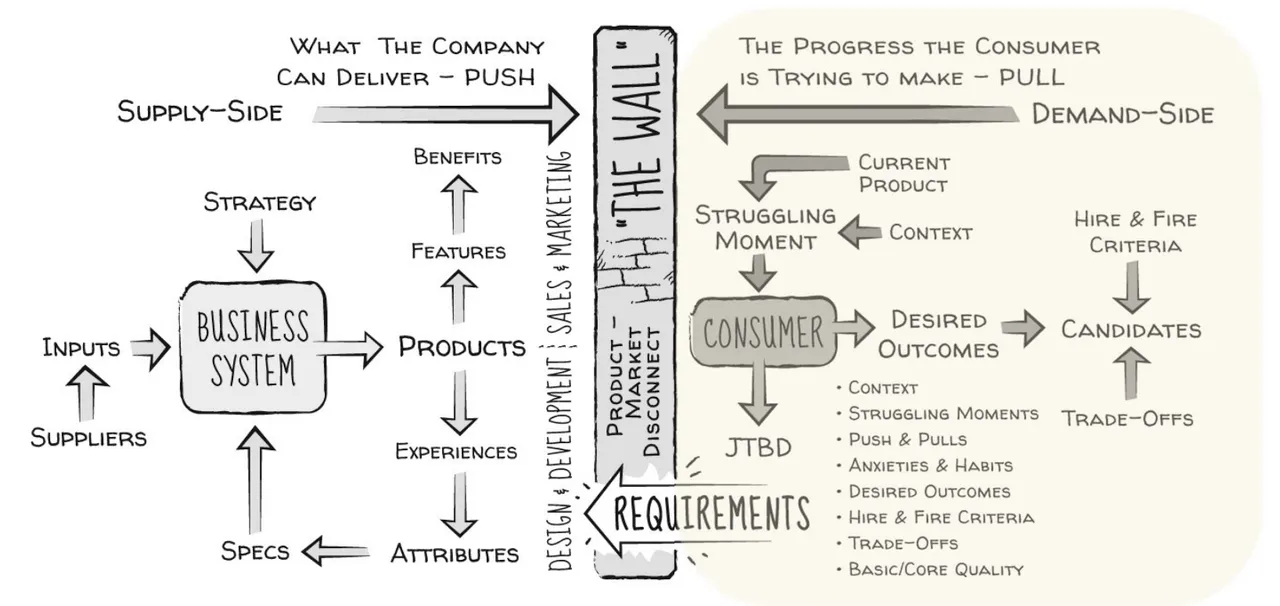
Bob co-developed the Jobs to Be Done theory with Clayton Christensen, documented in “Competing Against Luck”, which is a central building block of the shift to focus on the demand side.
More recently I discovered the work of Rob Snyder that builds on Moesta’s Demand Side and narrows it down for product-market fit.
Bob and Rob are repeatedly emphasizing how most products and their marketing are focusing on the supply side and how this is not resonating with the audience and their demand. Talking in supply side terms (features, benefits) and neglecting the anxieties and their habits of the present, which are — when unaddressed — holding them back.
Seeing the immensely successful examples that Bob and Rob are presenting is certainly a strong indicator of how much demand is not being addressed (directly).
Depending on the strength of the different forces, users will eventually say “yes” to a product or service.
A famous example that stuck in my head is the one where Bob is selling condos to “downsizers” — and he uncovered that what kept people from going ahead was the big old dining table, with all the connected memories — so they could not let go of it. They needed a space in the condo to put it — once there was room for it, many of them finally went ahead with the purchase.
It’s not only about the pull towards the new, but equally about addressing the habit of the current context and anxiety about the new solution.
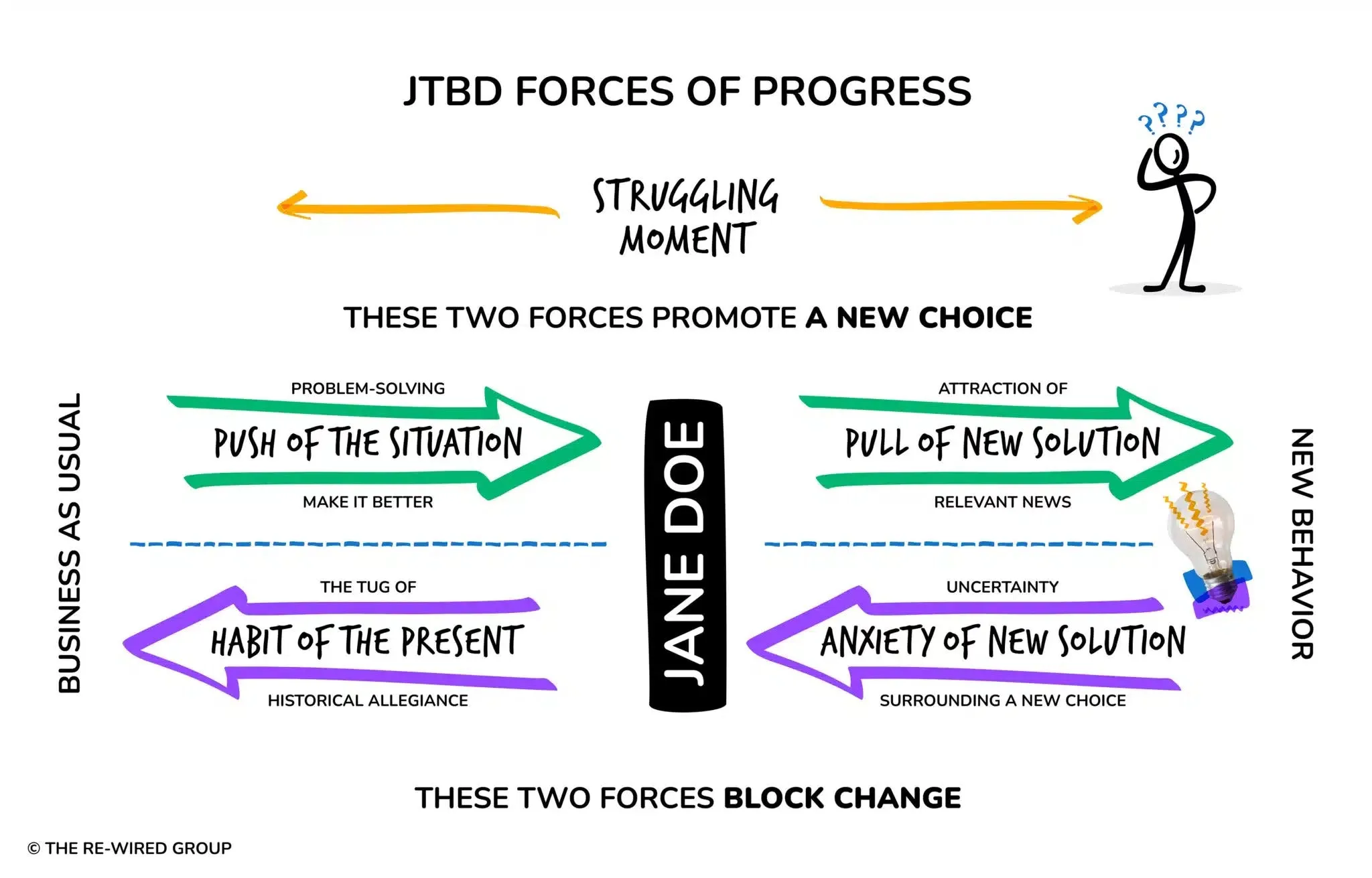 Image: © The Re-Wired Group
I find these takes on how to approach product development really energizing — repeatedly finding myself saying “yes, exactly that” and being grateful to get guidance on how to uncover the demand (pull) that is the basis for all steps that eventually happen when you — then, and only then — start to think of supply.
Maybe some of you might think now that finding demand for a product which does not exist yet is tricky, but demand always exists; it’s not tied to supply.
Rob Snyder recently recorded an episode and wrote about Latent Demand — for struggles which are pre-existing, which couldn’t be solved before but are now unblocked by e.g. technical advances. This is a nuanced way of uncovering the demand, yet it exists already.
Next to unblocking solutions for demand, there is also the fact that innovations most of the time cause new demand — e.g. now that AI can generate a convincing photo, voice or video, people struggle with something that barely existed before: how do I know what’s real?
As more and more of the supply-side work is being covered by AI these days, the crucial and differentiating part of building products will be how well we understand our customers’ jobs and the context they are in. Copying existing products is becoming cheap, but the supply is only half of the story. The knowledge around the struggle and addressing the changing needs is where the value lies.